
The other synth models
Four more models of old instruments are under Vintage Synths, and a wavetable synth is under Modern Synths. Each works like Tre: a panel, presets, automation, MIDI learn, undo and saving. None of them has been compared with what it’s modelled on (and Marbble isn’t affiliated with any of those makers); each has factory presets to start from.
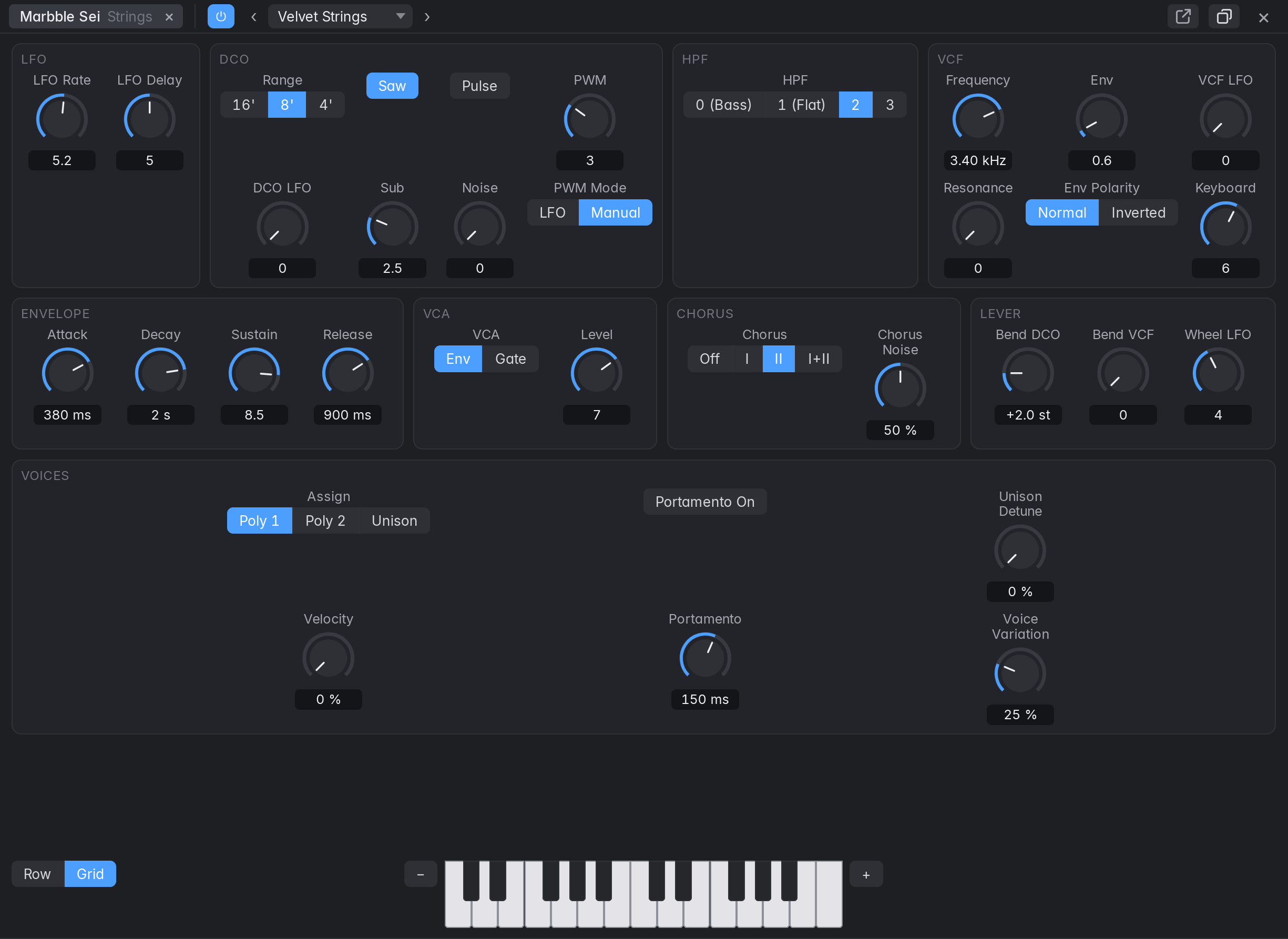
Marbble Sei (modelled on the Roland Juno-106 family): six voices of one oscillator each, with a saw, a pulse and a sub an octave down.
- One envelope drives the filter and the VCA (set the VCA to Gate for an organ-like note). One LFO moves everything together, with a Delay from the first key down.
- HPF: position 0 lifts the bass, 1 is flat, 2 and 3 thin it.
- Chorus: the stereo chorus is half of its sound. I and II are slow and deep, I+II fast and shallow. Chorus Noise is its hiss, which comes with the notes.
- Assign: Poly 1 moves on to the next voice, so released notes ring on, Poly 2 takes the lowest free one, and Unison plays all six on one note (they don’t beat unless you add Unison Detune).
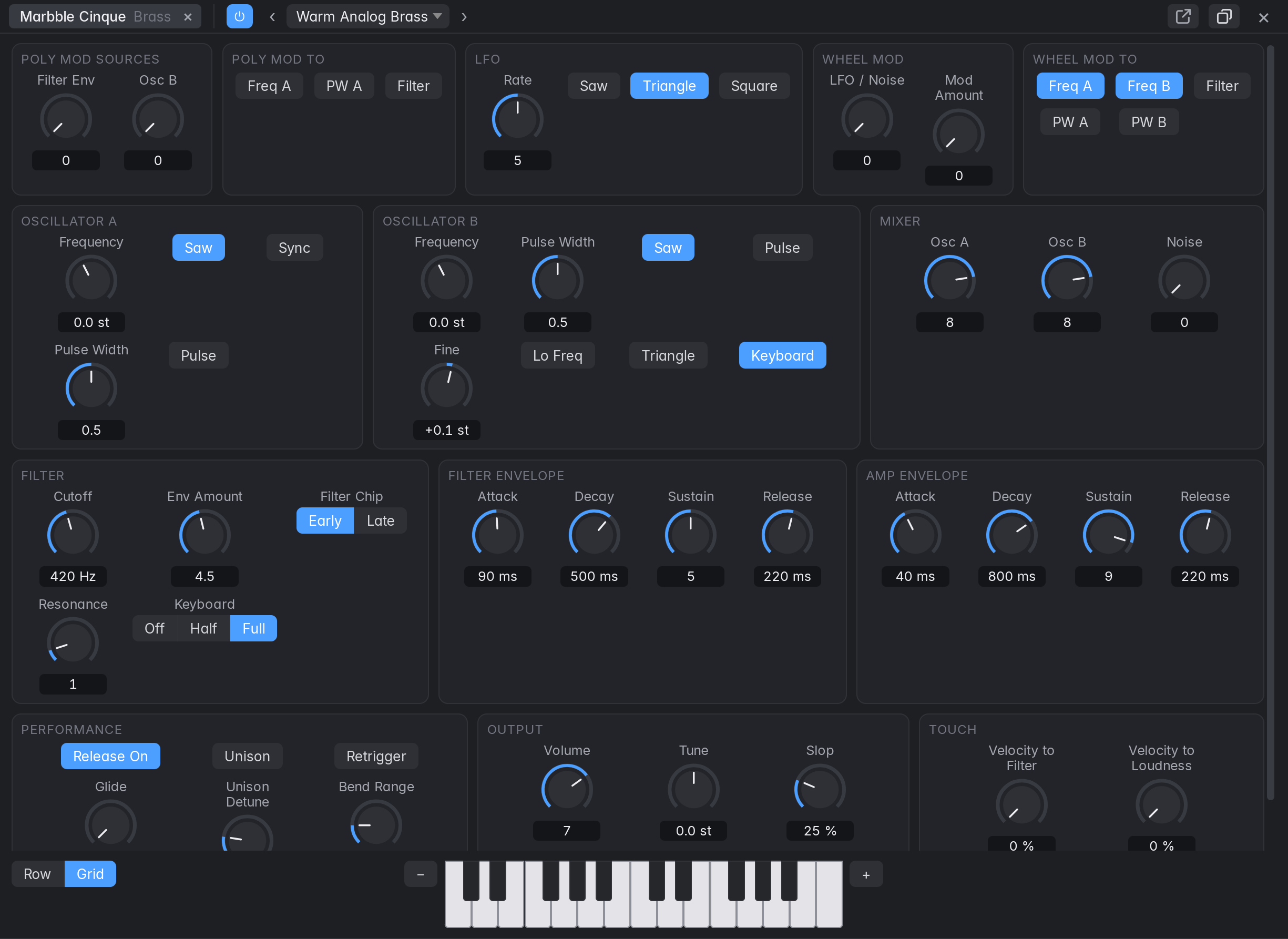
Marbble Cinque (modelled on the Sequential Prophet-5): five voices of two oscillators each.
- Poly Mod is what to try first: Filter Env and Osc B are its sources, and Freq A, PW A and Filter say where they go, separately in each voice. Osc B still runs with its mixer knob down, so it can be only a modulator. With Sync on Osc A and Filter Env into Freq A you get the sweeping sync lead this kind of synth is known for.
- Wheel Mod: the mod wheel (or Mod Amount, where it rests) brings in the LFO, or noise, by LFO / Noise, at whichever of the five switches are on.
- Filter Chip chooses between two filter characters. Slop is how much each voice wanders and differs.
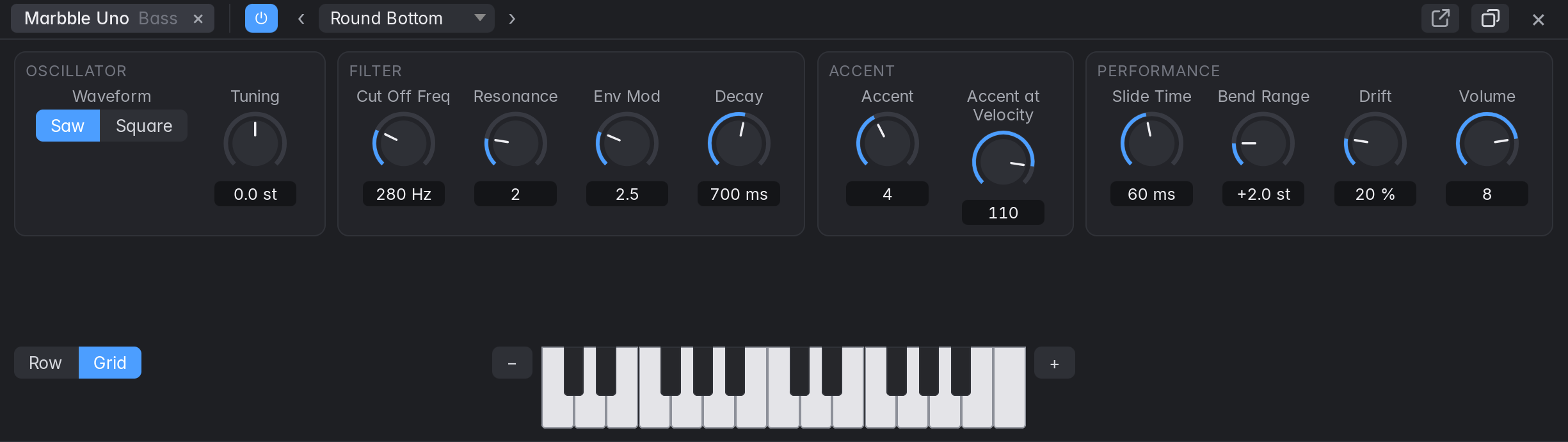
Marbble Uno (modelled on the Roland TB-303): one voice, one oscillator, and few knobs, made for a bass line played from a MIDI region.
- Overlapping notes slide: make a note end just after the next begins. Neither the filter nor the volume restarts. With any gap between them, the next is a fresh note.
- High velocity accents: a note at or above Accent at Velocity (110) is louder and snappier, whatever Decay says. How far is Accent. With Resonance up, accents close together climb: that’s the instrument’s trick.
- The filter doesn’t follow the keyboard, and a held note fades away by itself after a few seconds, as on the original.
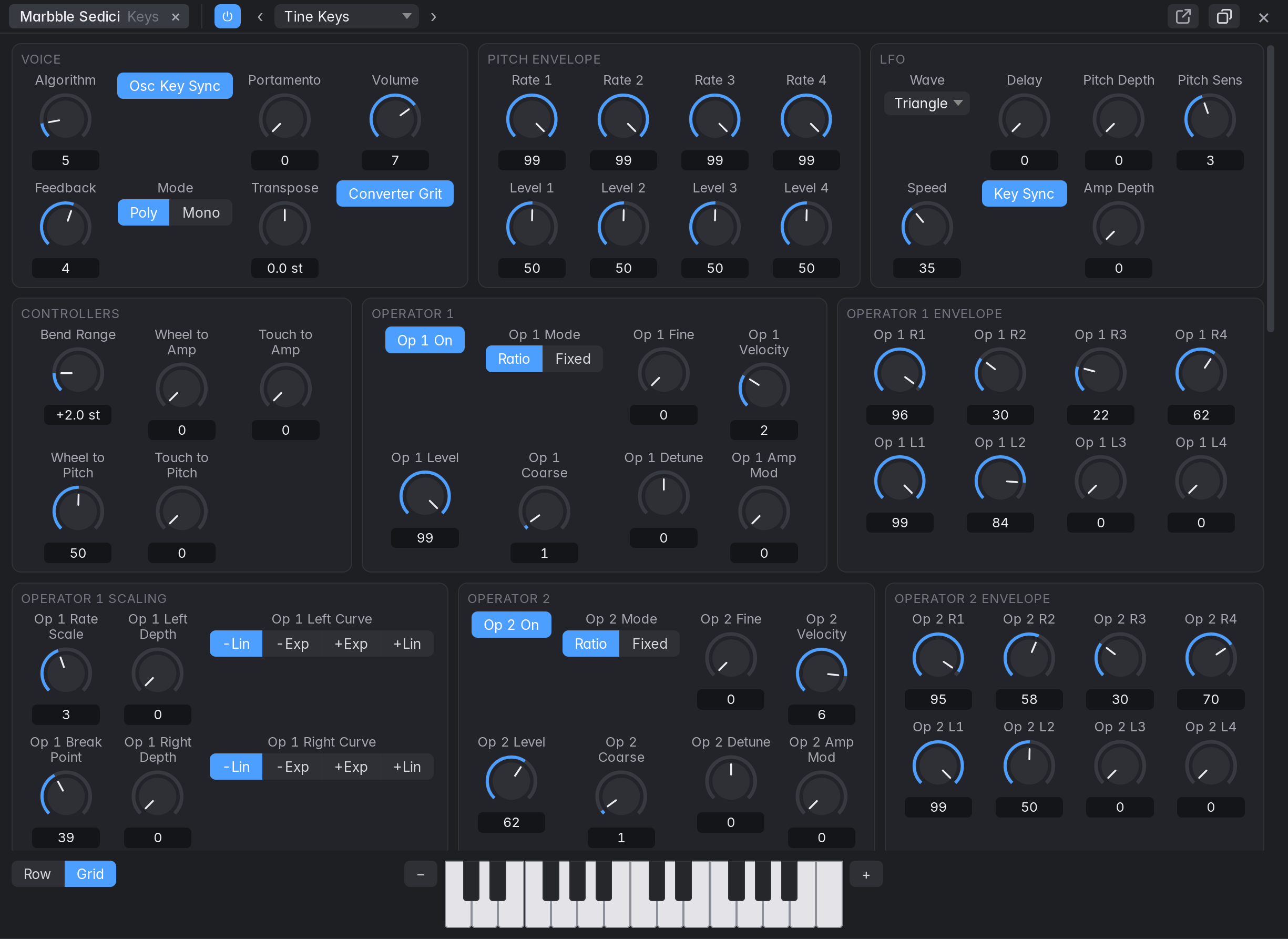
Marbble Sedici (modelled on the Yamaha DX7): sixteen voices of six-operator FM.
- Algorithm chooses which of the 32 ways the operators connect, numbered as on the original’s panel. An operator that goes to the output is heard; others change its tone, more as their Level goes up.
- Each operator has its own envelope of four Rates and Levels: it runs to Level 1, then 2, then 3 and holds, and to Level 4 on key up. Scaling makes it louder, softer or faster across the keyboard.
- Coarse and Fine give a ratio to the note’s pitch. Feedback makes an operator gritter or buzzier.
- Converter Grit turns the original’s low-resolution sine and converter on or off. It runs at the original’s own sample rate whatever your project’s is, so high FM sounds fold just as they do there.
- Level 4 above zero keeps a note sounding after key up, as on the original, until the transport stops.
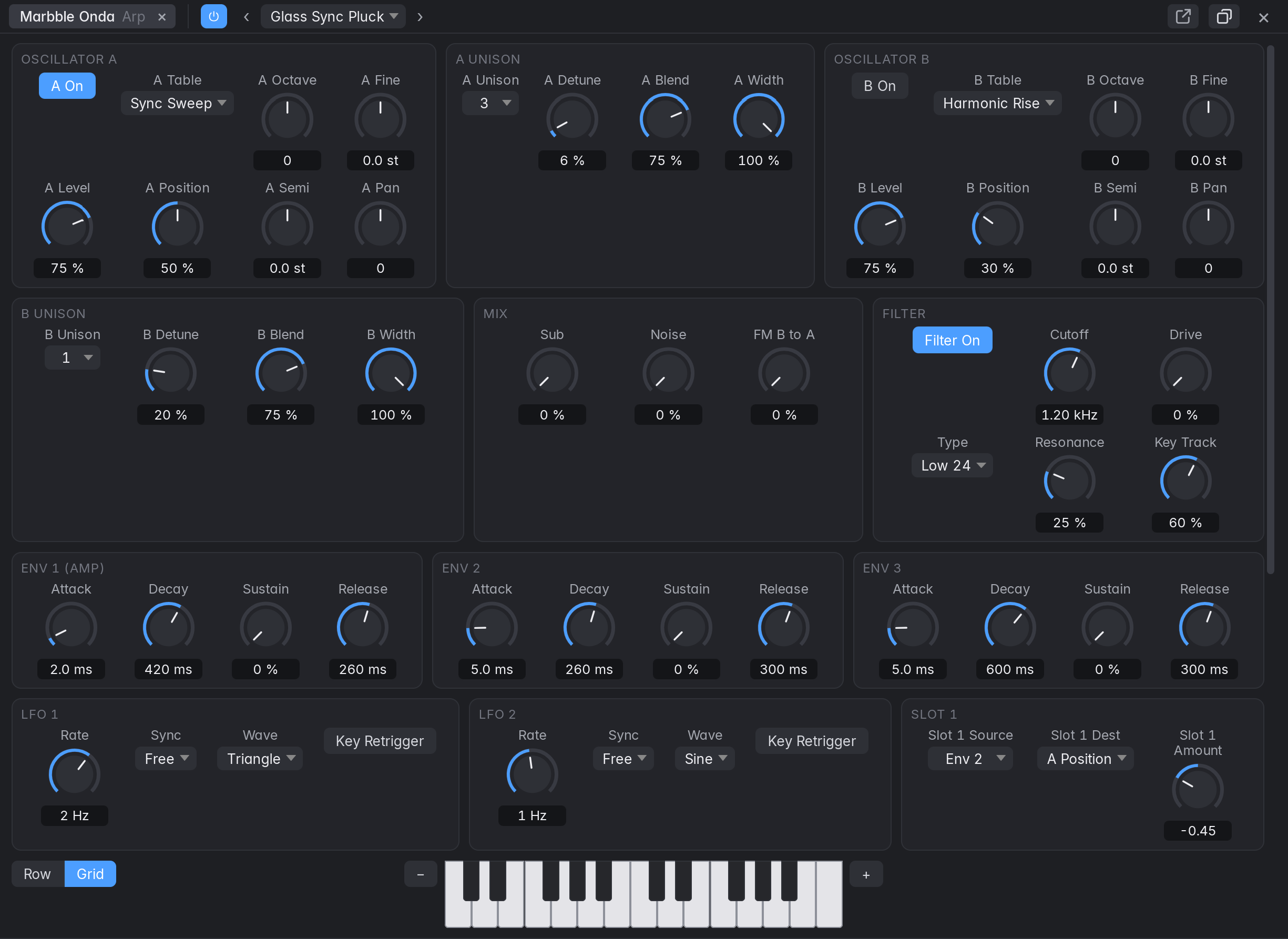
Marbble Onda (a modern wavetable synth): two oscillators reading tables made into it, with position, unison, and modulation you route yourself.
- Table chooses the sound, and Position moves through it. Each oscillator has up to 7 detuned Unison copies, spread in stereo by Width.
- Type chooses the filter. Env 1 is the volume.
- Env 2, Env 3, LFO 1 and LFO 2 do nothing until a Slot routes them: choose a source, a destination and an amount. Slots can also take velocity, the key, the wheel and aftertouch. Positions and cutoff are the usual places to start.
- An LFO’s Sync locks it to the tempo. Key Retrigger gives each voice its own, starting at the key.
- High settings are heavy: sixteen voices with seven copies in each oscillator is about a third of a core.